
How Much Does It Cost to Build a Dating App?

So, you have an idea that is going to change the way people find love. Maybe you have spotted a gap in the market that Tinder and Bumble missed, or perhaps you want to build a community for a specific niche. Whatever the spark is, the very first question that likely hit your mind is: how much is this actually going to cost?
The truth is that dating app development is a complex journey. It is not just about a pretty interface; it is about algorithms, security, and user psychology. In 2025 and 2026, the landscape has shifted. Users are no longer satisfied with just swiping; they want meaningful connections driven by technology.
In this guide, we will break down the financial realities of bringing a dating platform to life, from the basic MVP to the high-end features that make an app go viral.
The Current State of the Dating App Market
Before we look at the dollar signs, let’s look at why people are still investing in this space. According to recent industry reports, the global online dating market is projected to reach over 3.4 billion dollars by 2027. While it might feel like the market is saturated, the trend is moving away from “general” dating and toward “hyper-niche” experiences.
Investors are currently looking for platforms that solve “swipe fatigue.” Studies show that nearly 45 percent of dating app users have felt frustrated by the process in the last year. This frustration is actually an opportunity for new developers. If you can build a platform that feels more human and less like a digital chore, you have a winning product.
Breaking Down the Costs by Complexity
When you ask a developer for a quote, the first thing they will do is categorize your idea into a complexity level.
The Minimum Viable Product (MVP)
An MVP is the leanest version of your app. It includes the bare essentials: user profiles, geolocation, basic swiping or matching, and a simple chat function. For a startup, starting here is wise. It allows you to test your concept with real users without burning through your entire budget. Usually, a basic MVP will start around 30,000 to 50,000 dollars depending on the region of development.
Mid-Level Apps
This is where most successful apps sit. You might add social media integration, more advanced filters, and basic monetization like a “premium” tier. At this level, dating app development becomes more about the “stickiness” of the app. You can expect to spend between 60,000 and 100,000 dollars here.
Enterprise and Advanced Platforms
If you are looking to compete with the giants, you are looking at a high-end build. This includes custom animations, video calling, and high-level security protocols. These apps often cost 120,000 dollars or more.
The Core Components of Dating App Development
To understand where your money goes, you have to look under the hood. There are several “buckets” that consume the budget.
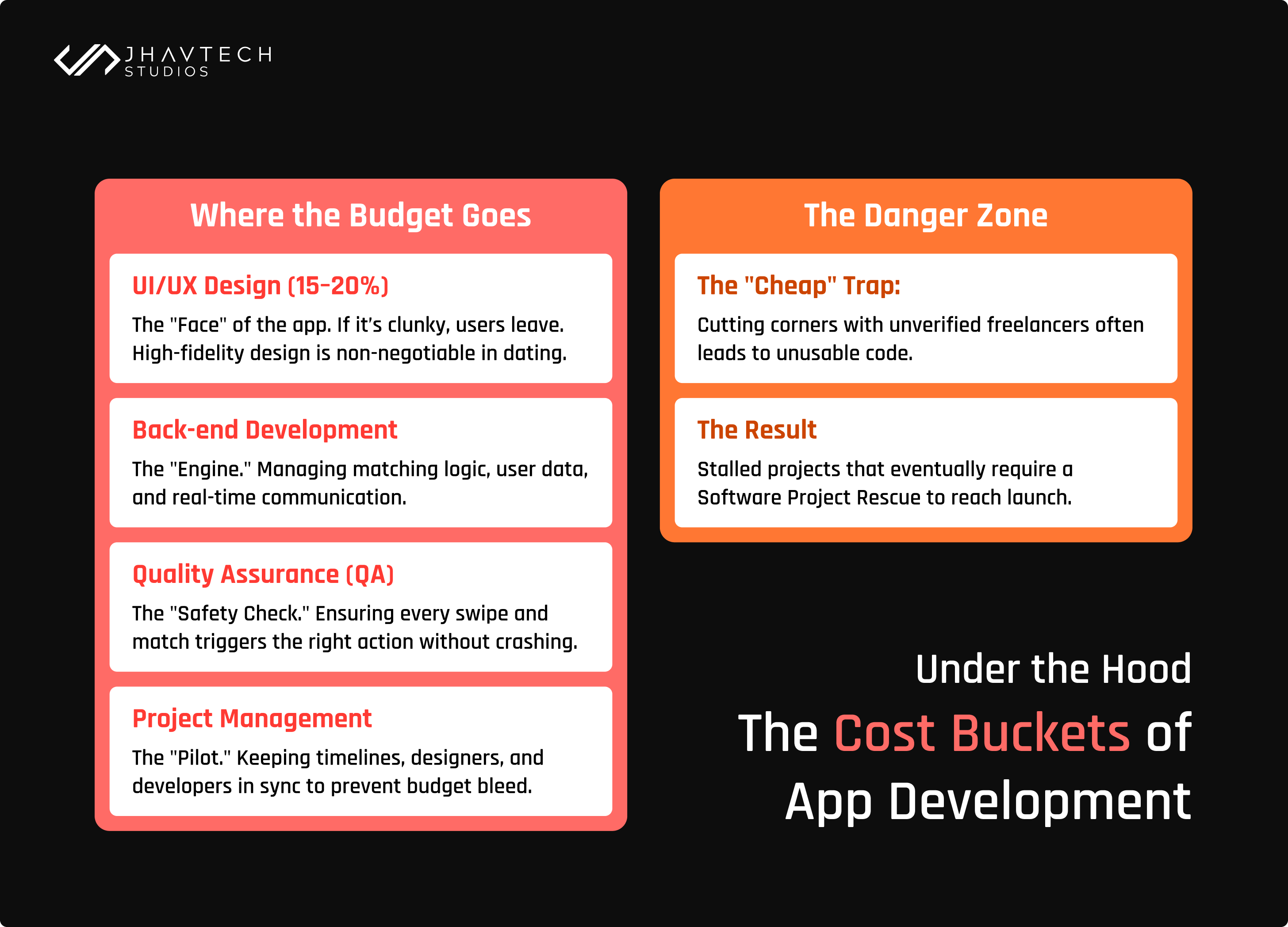
UI/UX Design: In dating, looks matter. If the app feels clunky or dated, users will delete it in seconds. Design usually takes up 15 to 20 percent of the total budget.
Back-end Development: This is the engine. It handles the data, the matching logic, and the communication between users.
Quality Assurance: You cannot launch an app that crashes. Testing ensures that the “match” actually results in a notification.
Project Management: Keeping the designers and developers on the same page is a full-time job that ensures the project stays on schedule.
Sometimes, founders try to cut corners by hiring unverified freelancers, only to find the project stalling or the code being unusable. In these cases, they often have to seek out a software project rescue to fix the underlying issues and get the product back on track for launch.
How Features Impact Your Budget
Every feature you add is a line item on your invoice. It is important to prioritize.
One of the most requested items lately is a clear breakdown of dating app features and cost. For example, adding geolocation sounds simple, but making it work in real time without draining a user’s battery requires sophisticated coding. Similarly, integrating a secure payment gateway for subscriptions adds layers of compliance and security testing.
The Rise of Artificial Intelligence in Dating
We cannot talk about the current market without mentioning AI. The days of simple “age and distance” filters are fading. Users now expect the app to learn their preferences.
This brings us to a major cost driver: AI-powered dating app development cost 2026. Implementing machine learning algorithms that analyze user behavior to suggest better matches can increase your initial development budget by 20 to 30 percent. However, the ROI is often higher because these apps see much better user retention rates. If the AI actually helps people find better dates, they stay on the platform longer.
Comparing Development Paths
How you choose to build your app is just as important as what you build. There are two main roads you can take.
White Label Solutions
A white label solution is essentially a pre-built app template that you “skin” with your branding. It is the fastest way to get to market. However, it is very limited in terms of uniqueness. If you want a specific, never-seen-before feature, a white label product probably won’t support it.
Custom Development
This is where you build from the ground up. While it is more expensive, it is the only way to create a truly proprietary algorithm. When evaluating the white label vs custom dating app development cost, most serious entrepreneurs lean toward custom builds because they offer better scalability and long-term value for investors. White label setups might cost as little as 5,000 to 20,000 dollars upfront, but they lack the flexibility needed to truly disrupt the market.
The “Tinder” Benchmark
Almost every client starts the conversation by saying, “I want something like Tinder.” It makes sense. Tinder revolutionized the industry with the “swipe” mechanic. But what is the actual cost to build an app like Tinder today?
While the original Tinder was built relatively cheaply as a hackathon project, replicating its current infrastructure is a different story. To build a platform with that level of smooth performance, global reach, and massive user load capacity, you are looking at an investment well into the six-figure range. You aren’t just paying for the swipe; you are paying for the ability to handle millions of swipes per second.
Hidden Costs You Need to Plan For
Your expenses don’t end when the app hits the App Store. In fact, that is just the beginning.
Server Costs: As your user base grows, your hosting fees will increase.
Marketing: You can have the best app in the world, but if nobody knows it exists, it won’t matter. Expect to spend at least 50 percent of your development budget on marketing in the first year.
Maintenance: Operating systems update, and bugs appear. You need a budget for ongoing dating app development to keep the app functional and secure.
Legal and Security Considerations
Dating apps handle incredibly sensitive data. You have users’ locations, private conversations, and photos. This makes you a target for hackers.
According to data privacy studies, dating apps are among the most scrutinized by regulators. You must comply with GDPR, CCPA, and other regional privacy laws. Investing in high-level encryption and secure servers is not optional. It is a fundamental part of the dating app development process that protects both your users and your legal liability.
Why Quality Matters More Than Ever
In 2026, the “low quality” app is dead. Users have too many options to put up with a glitchy experience. This is why choosing the right partner is vital. Many founders look at services like Jhavtech Studios for their expertise in creating seamless mobile experiences. When you look at specialized services like their dating application development service, you see that the focus is on creating a journey for the user, not just a set of features.
Final Thoughts...
Building a dating app is a significant investment, both financially and emotionally. While the entry price for an MVP might be around 30,000 dollars, a truly competitive product in today’s market will likely require a larger commitment to account for AI, security, and high-end design.
By focusing on a specific niche and prioritizing the right features, you can carve out a space in this multi-billion dollar industry. Remember that dating app development is not a one-time expense but an ongoing process of evolution. If you build with quality, security, and the user’s heart in mind, the return on investment can be life-changing for both you and your users.
Which feature do you think is a 'must-have' for a dating app in 2026? Is it AI-driven matching or better security? Let’s discuss below!